Invoices, GST and books that balance.
Deku Finance is a GST and financial operating system for Indian businesses. Raise invoices, post vouchers from the keyboard, have a second person approve them, and prepare GST returns from the same double-entry books.
18 guided workflows on sample books (best on laptop). No sign-up.
- UPI QR on every bill
- Live cash flow and P&L
- Team roles and approvals
- GST when you're ready
Start without GST. Switch it on when you register.
A small studio and a growing distributor need different paperwork. Deku keeps the same books underneath and changes what each bill carries.
Bills without tax clutter
For freelancers, studios and young businesses below the ₹20 lakh or ₹40 lakh registration limit. Send bills of supply with no monthly return to file.
Sample figures for a services business. Limits shown are general guidance.
UPI QR on every bill. Your UPI ID and the bill amount, ready for the customer to scan with any UPI app.
Bill of supply
KDS/26-27/0014
From
Kavya Design Studio
Not registered for GST
Mumbai, Maharashtra
To
Apex Growth Solutions LLP
Customer
Pune, Maharashtra
- PO number
- PO-2610-892
- Terms
- Net 15, due 3 Nov 2026
| Item | Qty | GST | Amount |
|---|---|---|---|
| Brand identity designSAC 998391 | 1 | – | 50,000.00 |
Scan to pay with any UPI app
kavya.studio@bank
Amount filled in: ₹50,000.00
Posted to the ledger
A sample bill from a fictional business.
The product, screen by screen
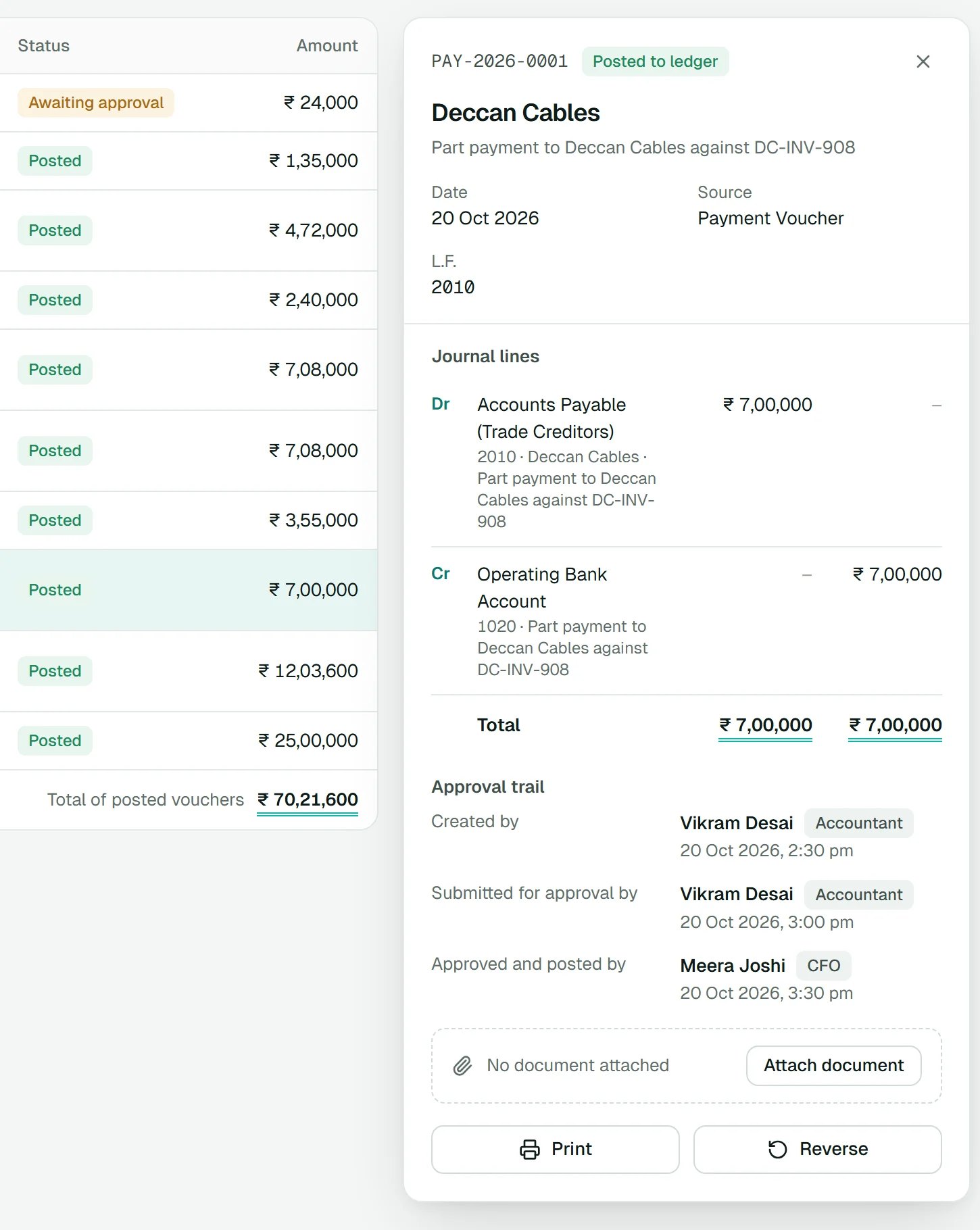
Every voucher shows who made it and who approved it
The Day Book lists every voucher in date order. Open one to see its journal lines, the debit and credit totals that must match, and the approval trail from created to posted.
Drafts wait in the approvals queue until an owner, CFO or admin signs off.
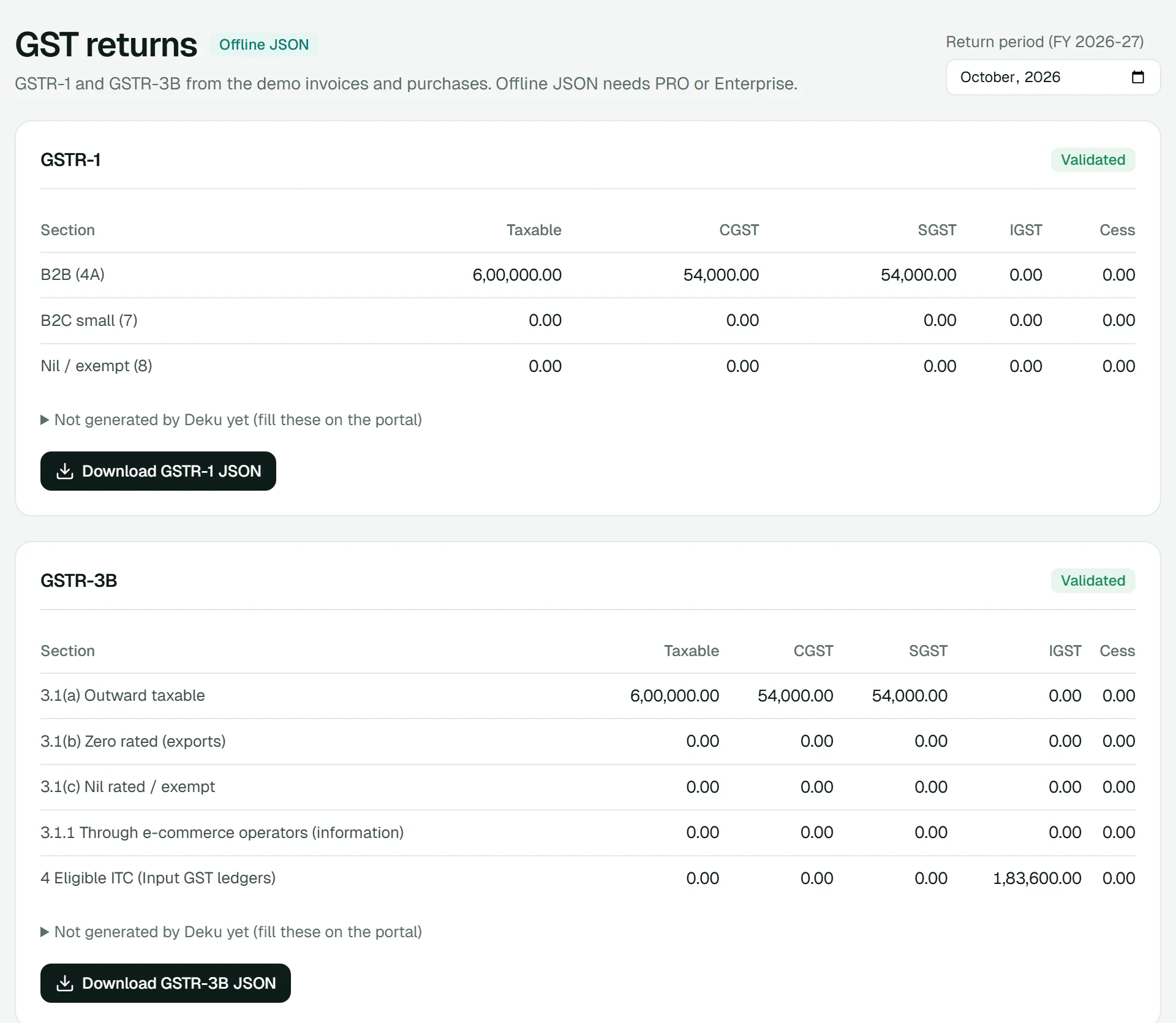
GSTR-1 and GSTR-3B, prepared from your invoices
Deku sorts sales and eligible credit into the return sections, validates them and gives you offline JSON to upload on the GST portal.
Sections Deku doesn't generate yet are listed on the screen. Filing straight from Deku needs a GST Suvidha Provider connection.
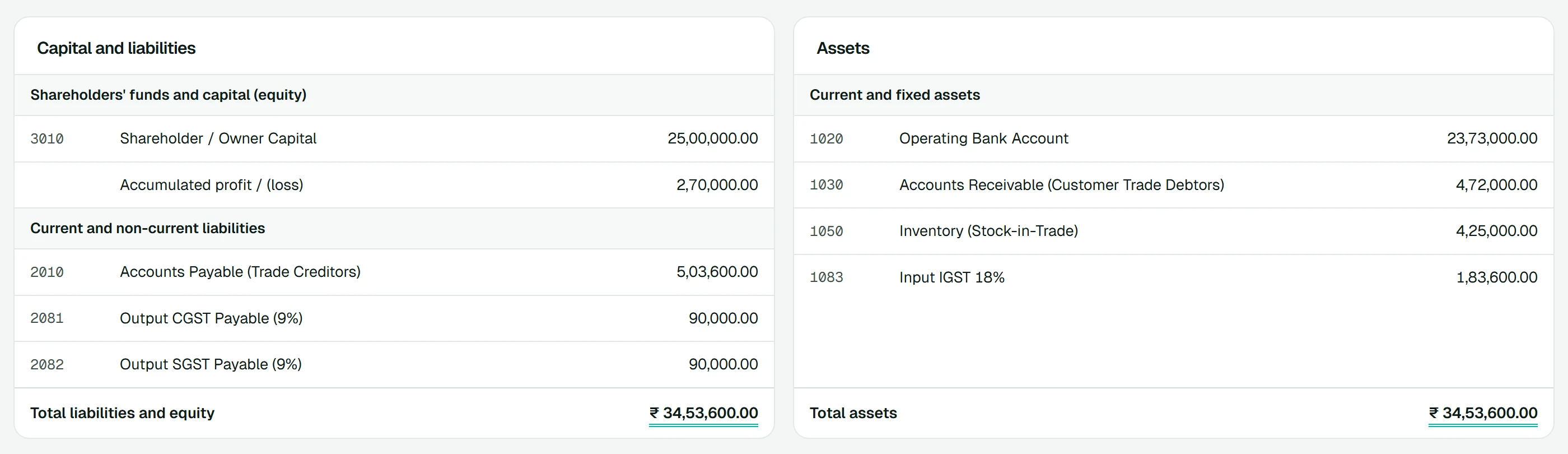
Statements that tie out to the rupee
Balance Sheet, Profit & Loss, Trial Balance, Cash Flow, General Ledger and debtor and creditor ageing are all computed from posted vouchers. When a statement balances, its totals carry the accountant's double rule.
- Inventory
- Items, warehouses and stock valued first-in first-out.
- Tally and CSV import
- Bring in masters, opening balances and vouchers.
- Deku Consultant
- Questions about your books, answered from the ledger with fixed logic.
- Seven roles
- Owner to auditor, each seeing and posting only what it should.
From the first bill to the balance sheet
Collections, keyboard entry, live statements and safe delegation, all working on the same double-entry books.
Start lean, switch on GST in the same books
Begin with simple bills while you grow. When you register, turn on tax splits and team workflows without moving to another tool.
Sample figures. Close to the limit, so it's time to register.
Books that balance themselves
Every rupee sits in Assets, Liabilities, Equity, Revenue or Expenses, so reports are right without spreadsheet fixes.
- AssetsGroup
- Current assetsLedger
- Bank accountsSub-ledger
- Operating bank accountLabel, takes entries
Debits equal credits on every voucher, or it doesn't post.
Explore the chart of accountsUPI QR on every bill
Your UPI ID and the exact amount, printed on the bill for any UPI app to scan.
kavya.studio@bank
₹24,890.00
KDS/26-27/0104
Paid straight to your own bank account
Know who owes you, and remind them on WhatsApp
Unpaid invoices are grouped by how long they've been due. One click opens WhatsApp with a polite reminder, the amount and your UPI ID already written. Your WhatsApp sends it; Deku doesn't.
- Due in 6 days
- Overdue 15+ days
- Over 45 days
Dear Apex Growth Solutions LLP, This is a reminder that ₹ 48,000.00 is due on invoice KDS/26-27/0084 (due date 17-Nov-2026). You can pay by UPI to kavya.studio@bank. Thank you, Kavya Design Studio
GST return files, prepared from your books
Sales and eligible credits are sorted into GSTR-1 and GSTR-3B summaries with offline JSON to upload on the portal. No mapping spreadsheets at month-end.
{
  "period": "Oct 2026",
  "taxable_sales": 600000.00,
  "eligible_credits": 183600.00
}
Summary figures from the Aster Trading demo books.
How GST works in DekuDelegate daily entry, keep the final say
Your team drafts bills, expenses and vendor entries. An owner or manager approves before anything posts, and the voucher keeps the trail.
- 1CreatedVikram DesaiAccountant
- 2Submitted for approvalVikram DesaiAccountant
- 3Approved and postedMeera JoshiCFO
Keep your hands on the keyboard
Every voucher has a function key and every register a letter, the way accountants who learned on desktop software already work. Press a key, or tap one, to see what it opens.
SalesTax invoice or bill of supply
B2B and B2C sales with place of supply, CGST, SGST or IGST, and a UPI QR.
- Enternext field
- Ctrl Entersave
The demo has the full key map. Try it on sample books
A clear chart of accounts for any kind of business
Every company starts on the same four-tier ALERX structure. Pick a business type below to see how its revenue, bank accounts, receivables and costs sit inside it.
Tier 1
Group
Assets, Liabilities, Equity, Revenue, Expenses
Tier 2
Ledger
Cash and bank, receivables, statutory taxes
Tier 3
Sub-ledger
Bank accounts, trade debtors, output GST
Tier 4
Label
The account you post to: a bank, a customer, hosting
On every label
Entries and value
How many entries it has, and its rupee balance.
Licences, retainers, cloud hosting and payment gateways. Gateway settlement ledgers, recurring revenue, hosting costs and output GST.
| Code | Group | Ledger and sub-ledger | Label | Sample entries | Sample balance |
|---|---|---|---|---|---|
| 1021 | AAssets | Cash and bankOperating bank accounts | Primary current accountReceives gateway payouts and client transfers. | 14 | ₹4,20,000.00 |
| 1031 | AAssets | Current assets and receivablesTrade debtors | Annual contract receivablesUnpaid invoices to annual contract clients. | 5 | ₹1,85,000.00 |
| 2081 | LLiabilities | Statutory and tax liabilitiesOutput GST | Output IGST 18%, software licencesTax collected on inter-state subscriptions. | 12 | ₹45,000.00 |
| 3010 | EEquity | Owner capitalShareholder capital | Founder capitalCapital put in at incorporation. | 1 | ₹5,00,000.00 |
| 4010 | RRevenue | Operating revenueProduct revenue | Monthly subscription revenueSubscription fees earned from customers. | 24 | ₹6,80,000.00 |
| 5030 | XExpenses | Operating overheadsTechnology and infrastructure | Cloud hostingMonthly server and hosting invoices. | 4 | ₹68,500.00 |
Entries can only post to labels. The database refuses a line posted to a group or ledger.
Set up your chartA standard chart from day one
No weeks of setup. Numbering follows the familiar pattern: Assets in the 1000s, Liabilities 2000s, Equity 3000s, Revenue 4000s and Expenses 5000s.
Entries counted as well as valued
Each journal line records the rupee amount and a count of the business event, so you can see how often something happens next to what it cost.
Reports that need no reconciling
Entries post only to labels inside the tree, so Profit & Loss, Balance Sheet and Trial Balance are computed straight from them.
Why Indian businesses choose Deku Finance
How Deku compares with the two kinds of tool most small businesses use today. Other products differ by edition and add-on, so treat their columns as typical, not exact.
Start without GST, add it later
Deku: Bills of supply first, GST invoices once you register, same books
- Desktop software
- GST set up per company, usually by an accountant
- Invoicing apps
- Often one invoice format
UPI QR on bills
Deku: On every bill, with the amount filled in
- Desktop software
- Usually through an add-on
- Invoicing apps
- Often a static QR image
Keyboard entry and balanced books
Deku: A key for every voucher; debits must equal credits to post
- Desktop software
- Keyboard-driven, with a learning curve
- Invoicing apps
- Mostly mouse-driven; often no general ledger
Live P&L and bank reconciliation
Deku: Reports from posted vouchers; statement CSV matched against the bank ledger
- Desktop software
- Reports available; statement matching varies by edition
- Invoicing apps
- Often invoice lists and sales totals only
Team approvals and GST limit tracking
Deku: Maker-checker approvals and a registration limit tracker
- Desktop software
- Varies by edition
- Invoicing apps
- Rarely available
| Capability | Deku Finance | Desktop accounting software | Invoicing apps |
|---|---|---|---|
| Start without GST, add it later | Bills of supply first, GST invoices once you register, same books | GST set up per company, usually by an accountant | Often one invoice format |
| UPI QR on bills | On every bill, with the amount filled in | Usually through an add-on | Often a static QR image |
| Keyboard entry and balanced books | A key for every voucher; debits must equal credits to post | Keyboard-driven, with a learning curve | Mostly mouse-driven; often no general ledger |
| Live P&L and bank reconciliation | Reports from posted vouchers; statement CSV matched against the bank ledger | Reports available; statement matching varies by edition | Often invoice lists and sales totals only |
| Team approvals and GST limit tracking | Maker-checker approvals and a registration limit tracker | Varies by edition | Rarely available |
One yearly licence for each stage of growth
Every plan is an annual licence with setup by a partner near you, product and tax updates, and your company's data kept to itself. No charge per invoice or per transaction.
GO
Clean books to start
Freelancers, studios and young businesses that want proper bills, UPI collections and books that are always up to date.
₹24,999a year
about ₹2,083 a month, billed yearly
- Seats
- 2
- Bills a year
- 2,000
- Catalogue items
- 100
- Non-GST mode with a registration limit tracker
- Bills of supply and GST tax invoices
- UPI QR on every bill
- Double-entry vouchers from the keyboard (F4 to F9)
- Day Book, Profit & Loss, Balance Sheet and Trial Balance
- GSTR-1 and GSTR-3B summary view
- Collections with WhatsApp reminder links
PRO
Most popularGST with a team
Growing businesses that bill other businesses, file GST every month and want a second person to check entries before they post.
₹49,999a year
about ₹4,167 a month, billed yearly
- Seats
- 5
- Bills a year
- Unlimited
- Catalogue items
- Unlimited
Everything in GO, plus
- GSTR-1 and GSTR-3B offline JSON for the portal
- Input tax credit register with section 17(5) blocked credit
- Bank reconciliation from a statement CSV
- All 7 roles and maker-checker approvals
- Payroll figures hidden from roles that shouldn't see them
- Marketplace settlement sheet import
- Payment links, once a payment provider is connected
Enterprise
Every branch, every warehouse
Organisations with more people, several locations and stock in more than one warehouse, who want the whole suite.
₹1,19,999a year
about ₹10,000 a month, billed yearly
- Seats
- Unlimited
- Bills a year
- Unlimited
- Catalogue items
- Unlimited
Everything in PRO, plus
- Unlimited seats
- Multi-warehouse stock with FIFO valuation and transfers
- Deku Consultant across every department, answered from your ledger
- Marketplace settlements across channels
- Direct GST filing, e-invoice and e-way bill through a GSP connection
- Cloud or on-premises deployment
- Dedicated account manager and accountant-led onboarding
Compare every plan, line by lineScale, invoicing, GST, books, reports and support across GO, PRO and Enterprise.
| Capability | GO₹24,999 a year | PRO₹49,999 a year | Enterprise₹1,19,999 a year |
|---|---|---|---|
| Scale and people | |||
| User seatsPeople who can sign in to the company. | 2 | 5 | Unlimited |
| Bills per yearBills of supply, tax invoices and credit or debit notes. | Up to 2,000 a year | Unlimited | Unlimited |
| Catalogue itemsProducts and services with HSN/SAC codes and tax rates. | Up to 100 items | Unlimited | Unlimited |
| RolesOwner, CFO, admin, accountant, analyst, auditor and viewer. | Admin and accountant | All 7 roles | All 7 roles |
| Maker-checker approvalsA second person approves a voucher before it posts. | |||
| Payroll privacySalary figures hidden from roles that shouldn't see them. | |||
| Invoicing and collections | |||
| Bills of supply and tax invoicesNon-GST bills below the limit, GST invoices once registered. | |||
| UPI QR on billsQR from your UPI ID with the amount filled in. | |||
| Payment linksCollect through a payment provider, once one is connected. | |||
| Collections and WhatsApp remindersWho owes what, and a reminder link to send from your WhatsApp. | |||
| Marketplace settlementsSales, commission and TCS from marketplace settlement sheets. | Manual journal | Settlement sheet import | Across channels |
| GST | |||
| Non-GST mode (section 22)Run without GST while below the registration limit, with a tracker. | |||
| Tax by place of supplyCGST and SGST within the state, IGST across states. | |||
| GSTR-1 and GSTR-3BPrepared from your invoices and purchases. | Summary view | Offline JSON for the portal | Offline JSON; direct filing through a GSP |
| Input tax credit registerEligible credit kept apart from section 17(5) blocked credit. | Purchase register | ||
| E-invoice and e-way billIRN, signed QR and e-way bills through a GST Suvidha Provider. | Needs a GSP connection | ||
| Books, stock and banking | |||
| Double-entry ledgerDebits must equal credits; server-issued voucher numbers. | |||
| Vouchers from the keyboardContra, payment, receipt, journal, sales and purchase (F4 to F9). | |||
| Bank reconciliationMatch a statement CSV against the bank ledger. | Cash and bank book | Statement CSV matching | Statement CSV matching |
| InventoryStock valued first-in, first-out. | One location | One warehouse | Multiple warehouses and transfers |
| Reports and Deku Consultant | |||
| StatementsProfit & Loss, Balance Sheet, Trial Balance and Cash Flow from posted vouchers. | |||
| Ageing, DSO and DPOWho owes you, whom you owe, and for how long. | |||
| Deku ConsultantAnswers from your ledger with fixed logic, not an outside AI service. | Every department | ||
| Deployment and support | |||
| DeploymentWhere Deku runs. | Your own deployment | Your own deployment | Cloud or on premises |
| SupportHow to reach us. | Email and help centre | Phone and WhatsApp | Dedicated account manager |
Every plan: balanced double-entry books, an audit log and no shared passwords.
Licensing questions: +91 75064 61004
Questions, answered
Something else on your mind? Request a setup and we'll help you directly on WhatsApp.
Invoicing, UPI collections, expenses and profit reports live in one workspace. Every invoice or payment you record is a double-entry voucher, so the Balance Sheet, Profit & Loss and cash position are always computed from the same books instead of separate spreadsheets.
Yes. Without GST you send clean bills of supply with a UPI QR and no tax lines. A registration limit tracker shows how close your turnover is to the ₹20 lakh or ₹40 lakh limit (general guidance; your own position can differ). When you register, switch the company to GST and turn on team workflows.
Each bill can carry a QR made from your UPI ID with the amount and bill reference filled in. Customers scan it with any UPI app, so there's nothing to type and less back-and-forth about how to pay.
Collections groups unpaid invoices by how long they've been due and flags amounts owed to micro and small enterprises for more than 45 days. A WhatsApp button opens your own WhatsApp with a polite reminder, the amount and your UPI ID written in. Deku doesn't send messages itself.
Yes. The document builder makes quotations, proforma invoices, delivery challans and estimates. When the client agrees, convert the document into a sales invoice without typing the lines again.
Staff and bookkeepers draft entries; an owner, CFO or admin approves them before they post to the ledger. Each voucher keeps its trail: who created it, who submitted it and who approved it.
Choose the bank account and a statement CSV. The file is read in your browser and matched against the bank ledger by date, reference and amount. Matches are suggestions until you confirm them, and the completed reconciliation is recorded with who did it.
Once GST is on, Deku splits CGST and SGST or IGST from the place of supply, tracks eligible input tax credit from your purchase register, and prepares GSTR-1 and GSTR-3B summaries with offline JSON to upload on the portal. Filing directly from Deku, e-invoices and e-way bills need a GST Suvidha Provider connection.
ALERX organises every account under Assets, Liabilities, Equity, Revenue and Expenses, in four tiers from group down to the label you post to. Every company starts with a standard chart, so cash, bank, receivables and expenses are structured from day one.
Deku runs in your own deployment, so your books stay there. Deku Consultant answers from your ledger with fixed logic and doesn't send figures to an outside AI service. Seven roles control who can see and post what, including payroll figures.
Yes. Reports, registers and ledgers download as CSV, and GST returns as JSON. Your data belongs to you.
Try it on sample books
18 guided workflows run on the real screens, from issuing an invoice to closing the month. Pick one of 4 fictional companies and any of the seven roles on a desktop or laptop browser. No sign-up; the sample books stay in your browser.